

Skip to content

    What I Learned in the Dirt

    Softness is the Only Way to Stay Whole

    Alex
    January 5, 2026
    10 min read
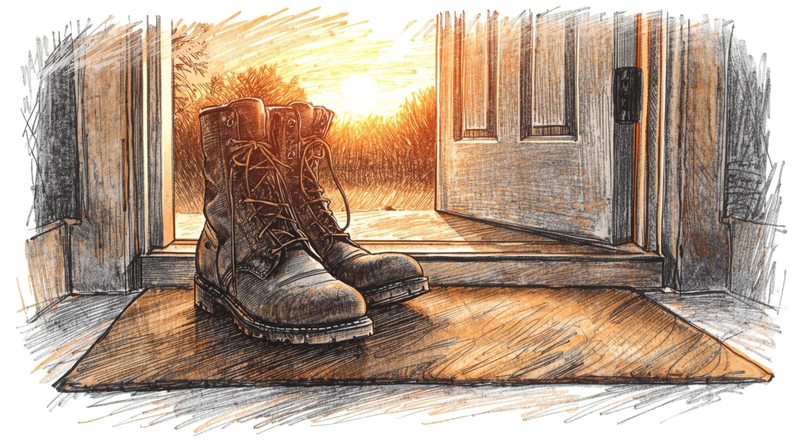
    A landscaper's work boots at the door at sunset, symbolizing the transition between hard work and soft rest

    The Transition ZoneLink to section

    The smell of cut grass and two-stroke engine exhaust is stubborn. It clings to my skin long after I've clocked out. Even as I pull into the driveway, my hands still feel the ghost-vibration of the commercial zero-turn mower I've been piloting for ten hours. It's a low-frequency hum that settles into your bones.

    For a long time, I thought "being a man" meant absorbing that vibration until you became just as rigid as the machines you operate. But out in the dirt, you learn something about materials: the things that are too hard, too brittle, are the first things to snap under pressure. Concrete cracks. Oak limbs shatter in high winds. But the things that can give—the things that have a bit of "softness" in their design—are the ones that survive the storm.

    I peel off my work boots at the door, a physical boundary between the world that demands grit and the world that allows for breath. Four years of landscaping for my uncle's business has taught me the "Landscaper's Mask." Out there, I'm the guy who doesn't complain when the blower kicks back dirt into my face, who can operate a Bobcat and deadlift bags of mulch with men twice my age. In here, I get to be the guy who needs the lights dimmed and the world quiet.

    I'm 25, AuDHD, and I've dealt with depression since I was nine. I've realized that the only way to keep doing the hard work is to give myself permission to be soft when the work is done. It isn't a lack of grit; it's the infrastructure maintenance that keeps a protector from burning out.

    This guide is Part 4 of our Autistic Independence series. For the complete roadmap on transitioning to adulthood as an autistic person, read our Sovereignty Through Softness Pillar Guide.

    The Village I Needed

    Yeah, I live at home. In 2025, that's not a "failure to launch"—it's just expensive housing math and choosing what matters. My parents work full-time, and my grandparents reached a point where they couldn't live independently. We chose to pool our resources.

    My Morning Routine: I'm up at 4:30 AM—earlier than everyone else. The house is quiet and dark, just the way I need it to be. I take my meds and drink coffee in that peaceful stillness, setting things up for my grandparents. I lay out their medications in the pill organizer so there's no confusion. I prep the coffee maker so my grandmother just has to press a single button. I set the breakfast things within easy reach on the counter—small acts of engineering that save them energy later.

    Then I'm out the door by 6:00 AM, back by 3 PM to pick up where I left off—managing meds, coordinating doctors' appointments across town, and cooking dinner. I was a lonely only child, and having this village around me has always been the counterweight to my depression. Even when the "gray filter" descends and I'm observing the good without always being able to feel it, their presence anchors me.

    I love my grandparents. I love their stories and the way they still laugh at my terrible jokes. But the load is real. Caregiving is masculine work, but it requires you to stay whole. The nest isn't where I hide; it's the only reason I can wake up at 4:30 AM and do it all again.

    Casualties of the Grudge

    I watch the men on my crew. There's a guy in his fifties who winces every time he climbs off the mower. His hands shake from nerve damage. He'll never admit he's in pain; he just pops Advil like candy and shrugs. "Docs can't do nothing anyway," he tells me, eyes fixed on the horizon.

    Then there's the one who mocks the younger guys for wearing sunscreen, despite the suspicious spots on his own arms he refuses to acknowledge. And the quiet one—maybe fifty-five—who moves a little slower each season, never complaining, just grinding until he's a ghost of himself.

    They aren't trying to be cruel. They're just teaching what they were taught: Your body is a tool. Use it until it breaks.

    I can pass their tests of endurance. I'm young and strong. But I'm watching these men destroy their bodies to prove something that won't matter when they're too broken to work. They grew up when "provider equals identity" was a viable path. That contract is dead. Even if I worked myself into the ground like they did, I still couldn't afford what they have. I'm being a man by knowing exactly when my nervous system needs to clock out. I refuse to be a casualty of a dead myth.

    The Seasonal Anchor

    Landscaping is a seasonal gamble. From April to October, I'm working forty-hour weeks across four days, and my body is breaking down by August. From November to March, the work disappears.

    Winter is financially anxious, but it is mentally survivable. I have time for therapy. My medication has space to actually work without being sweat out in a 100-degree field. I can be present for my grandparents without feeling like I'm running on fumes.

    Because the world outside is so unstable, the nest becomes my only constant. When everything else shifts beneath me, I need to know my room is exactly the way I left it—lights in the same position, afghan folded on the same corner of the bed. That consistency is the foundation I can control when the economy or the weather doesn't care about my plans.

    The Load I Choose

    I feel like a hermit crab. I carry this heavy shell of responsibilities—work, caregiving, family expectations. But I can't just find a bigger shell when this one gets too heavy. I have to make the inside softer so I can survive the weight.

    By 8 PM, I've been "on" for fifteen and a half hours. My day isn't just mowing; it's the emotional labor of watching my grandparents decline. My grandfather forgets things now—small things at first, but the trajectory is clear. My grandmother's mobility gets worse each year. I help her with tasks she used to do herself, and we both pretend not to notice the shift.

    Success isn't living alone in a studio apartment. Success is being present for people while they're still here. I'm trying to soak up their wisdom and memorize their stories, knowing this chapter has an expiration date. That takes energy people don't see. The "failure to launch" monologue in my head is loud, but I'd rather "fail" at being independent than "succeed" at being alone while the people I love fade away.

    The Drain No One Counts

    Even when I like my coworkers, being around them for ten hours is exhausting. For an introvert with AuDHD, socializing is like running a background program that eats 30% of your processing power just to appear "normal." The Verywell Mind guide on autistic masking explains why this drains so much energy.

    Add the sensory assault: mowers, blowers, traffic, heat, sun glare. By lunch, I'm sensorily saturated. By the end of a shift, I barely have words left. This is why the nest isn't "me time"—it's a system recharge.

    I also do community outreach, speaking at schools about teen depression. I believe in it, but standing in a gymnasium talking about suicide prevention drains me for days. I spend my limited social energy on speaking up because silence costs more. But I need the nest to make that math work. The nest provides exactly what my overstimulated nervous system needs: low lighting, silence, and predictable textures.

    The Reset Button

    My body doesn't know the difference between a loud lawnmower and a threat. My nervous system is stuck in the "on" position. In clinical terms, my HPA-axis—the body's alarm system—is chronically activated. As Harvard Health explains, this chronic stress takes a physical toll.

    By Sunday afternoon in peak season, my hands shake. My jaw is clenched. This isn't just "tired." This is a nervous system that thinks it's being hunted. You can't logic your way out of a nervous system crisis. Telling myself to "man up" won't lower my cortisol levels.

    The nest provides biological ramps from fight-or-flight back to rest-and-digest. The weighted texture of my crochet afghan provides deep pressure stimulation. It signals to my body: we are safe enough to rest. You wouldn't tell someone with a broken leg to "just walk it off" without a cast. My nest is my cast.

    The Ethics of Masculine Innocence

    I was nine years old the first time the gray filter descended. I was lonely, an only child in a house where everyone worked long hours. I needed comfort then, but I didn't know how to ask for it. I didn't even know I was allowed to need it.

    That's what the nest is. It's strategic regression. I find comfort in "weird VHS tapes" and retro games—things from a time before I knew I had to perform. This isn't childish. I'm the protector who also needs protection. I wake up at 4:30 AM to set out medications, but I also wrap myself in a blanket cocoon to watch nature documentaries. These things aren't contradictory. They're how I stay whole. I'm giving that nine-year-old kid the safety he needed but couldn't access.

    Building Forward

    I know this chapter has an expiration date. My grandparents won't be here forever. That terrifies me, but it makes me show up fully now. I'm saving money for a future where I can afford a place that accommodates my nervous system.

    Climate control, a low-stimulation environment, and space for my "infrastructure" are non-negotiable. Success is building a life where you don't have to survive alone. If I ever have a household of my own, I want it to be like this: resource-sharing, built for care, and honest about what we need to stay functional.

    The Scenic Route Manifesto

    If I could talk to ten-year-old Alex—the kid who first felt the gray filter descend—I'd tell him this: Hey. It's going to be gray for a long time. But you're going to build something that works for you. The people who love you won't require you to be hard all the time. Hold onto them.

    Softness isn't the opposite of strength. Softness is the foundation of sustainable strength. If you're reading this from your own nest—working a physical job and going home to soft things—you aren't less of a man. You're just honest about what keeps you functional. If you're living with family, caring for people, choosing the scenic route over the highway—you're not failing. You're surviving in an economy and culture that set us all up to fail.

    The world is hard enough. You have full permission to be soft.

    Right now, my water bottle is four inches too far to the left. I could unwrap from the cocoon and grab it. Or I could just stay here, wrapped tight, and deal with being thirsty for another ten minutes. It's always something, right? :)

    But I'm still here. Still wrapped up, still taking the scenic route to wherever I'm supposed to be. And today, just being here is enough.

    Start Small: Your Nest Audit

    What is one thing you can add to your space today to make tomorrow easier?

    • A water bottle within arm's reach
    • A charger that stays exactly where you rest
    • One item with a texture that actually feels good on your skin
    • Lights you can dim without standing up

    You don't need to earn your rest. You just need to survive.

    Continue Your Journey

    Alex
    Contributor

    A dedicated nature steward and AuDHD advocate, Alex finds his true north outside—tending to gardens, farms, and the quiet dignity of growing things. Deeply connected to animals and all things tender, he explores the intersection of masculinity and softness. Alex writes to validate the 'scenic route,' proving that a life spent nurturing the small and the vulnerable is a life of profound strength.

    Cancer ♋
    Gen Z