- • Setting reminders (ignored if activation isn't there)
- • Scheduling hygiene like meetings
- • Guilt or self-criticism as motivation
- • Making the space more "practical"
- • Telling yourself it only takes 5 minutes
The Impossible TaskLink to section
Y'all, I literally sat on the bathroom floor for 45 minutes yesterday because I could not make myself get in the shower. I kept meaning to. I wasn't sad. I wasn't even particularly tired. My brain just looked at the grey tile, the generic white soap, the fluorescent light, and flatly refused to participate. This is the "Impossible Task" — and it is more common than anyone talks about.
The Impossible Task is a specific phenomenon in ADHD and executive dysfunction: a task that is completely within someone's physical capability becomes functionally impossible due to a wall of brain resistance that defies logic. It is not about intelligence or motivation. It is about whether the brain can generate enough engagement to initiate and sustain the action.
And here's what nobody tells you: the environment matters enormously. The brain's decision to engage is partly an aesthetic one. If the space feels dead — grey, boring, cold — the executive function cost of entering it goes up. If the space feels alive and rewarding, the cost drops. This is not a theory. It's why restaurants play music.
Executive Dysfunction Is Not LazinessLink to section
Executive dysfunction affects the brain's ability to initiate, plan, sequence, and complete tasks. The executive functions — working memory, cognitive flexibility, inhibitory control — are managed by the prefrontal cortex, which in ADHD brains is underactivated and underlevel in dopamine availability.
This is why ADHD hygiene struggles are so common, so under-discussed, and so misunderstood. "Just do it" genuinely doesn't work when the part of your brain responsible for "just doing it" is running on fumes. The solution isn't willpower. It's dopamine architecture.
- • Attaching a reward to a task (dopamine pairing)
- • Making the space intrinsically appealing
- • Body doubling (podcast or music in bathroom)
- • Sensory novelty that the brain wants to engage with
- • A single, appealing item that requires the task to access
What Dopamine Decor Actually IsLink to section
Dopamine decor is the intentional use of aesthetic joy as a functional tool for executive dysfunction management. You make a space so visually and sensorially rewarding that the brain wants to be in it — which is exactly the friction reduction needed to decrease the activation cost of tasks performed there.
It is not about clutter or chaos. It is about selecting items that your specific brain finds genuinely dopaminergic: colors that make you feel something, scents that snap you into presence, textures that feel good to touch, items that have a personality. For me, that means objects that look like they belong in a cartoon bakery.
The key principle:
Dopamine decor works because it changes the cost-benefit calculation your executive function makes. A grey bathroom says "go in, do the thing, leave." A candy shop bathroom says "go in, look at the cute soap, smell the lovely thing, do the task because you're already here." The task gets completed as a byproduct of wanting to be in the space.
The Paw Print Soap HackLink to section
The Paw Print Soap Hack
This might sound silly, but this soap isn't just cute — it's a dopamine bribe. The logic: I want to touch the little jelly-bean toes on the soap. I want to smell the strawberry milk scent. But to access those things, I have to wash my hands. The task becomes the price of admission to something I actually want.
This is not a trick I play on myself. This is architecturing my environment so that doing the right thing is the path of least resistance. Same principle as "temptation bundling" in behavioral psychology. Except cuter.
- Scent: Strawberry Milk (the most important part)
- Texture: Smooth, satisfying, shaped like a paw
- Visual: So cute it's annoying. In the best way.
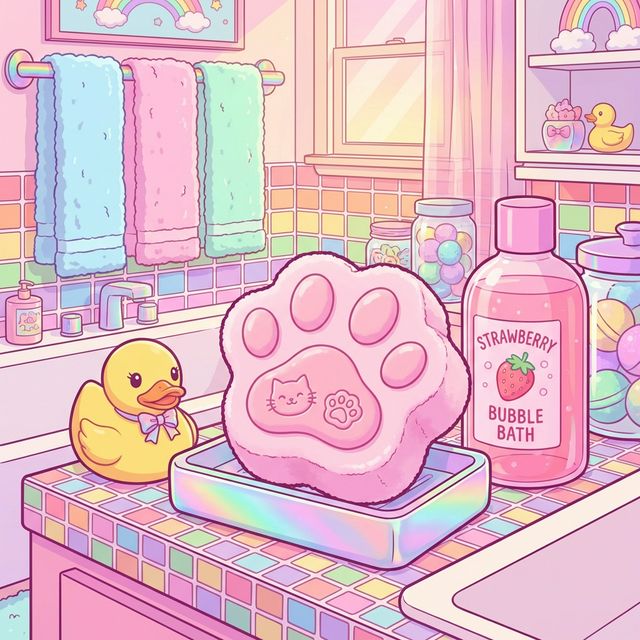
Building Your Candy Shop BathroomLink to section
You don't need to redo your bathroom. You need to change what you put in it. Here are the highest-ROI dopamine decor additions by category:
🌸 Scent
- Strawberry, vanilla, or bakery-sweet soaps
- A wax melt warmer with a gourmand scent
- Shampoo with a scent you look forward to using
🌈 Color
- Replace white soap dispenser with a colored one
- One brightly colored towel
- A small printed poster or art print you actually love
✨ Texture
- A soap bar with a fun shape (shell, star, paw)
- A fluffy new washcloth in your favorite color
- A holographic soap dish or tray
🎀 Joy Items
- One tiny figurine or object near the sink
- A small plant (low-maintenance)
- A disco ball or prism for rainbow light
Dopamine Decor Starter List (Lowest Effort, Highest Impact)Link to section
1
A scented soap in a shape you love
This is the single highest-return item. Scent is processed in the limbic system (emotional brain) first — it bypasses the prefrontal cortex resistance.
2
Change the lighting
Swap cold white bulbs for warm bulbs or add a small LED fairy light strip. Cold fluorescent light is genuinely hostile to dopamine-seeking brains.
3
Put something cute on the shelf
One small figurine or item you love transforms a functional space into a personal one. The personalization itself reduces resistance.
4
A playlist that ONLY plays in the bathroom
Novelty + ritual. The songs are only available when you're doing bathroom tasks. Your brain will start associating the playlist with entering the space.
5
Replace your washcloth with a new color
The cheapest, fastest environment change possible. Novelty is dopaminergic. New things catch attention where familiar things don't.
Start with one thing. Not the whole list. Overwhelm kills momentum faster than a grey bathroom does.